



Bearing Capacity of Lunar and Martian Regolith
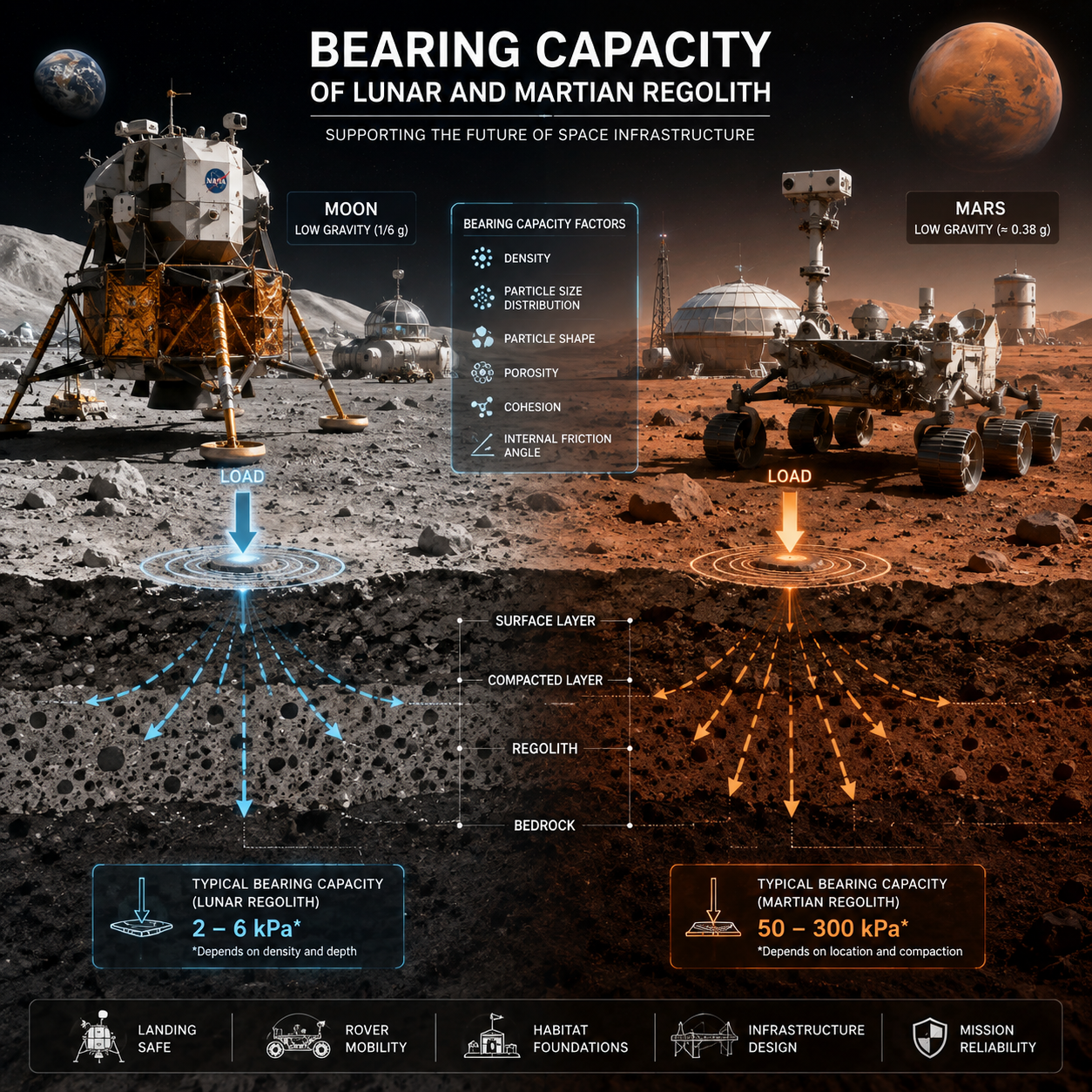
Bearing Capacity of Lunar and Martian Regolith
Bearing capacity is one of the most important geotechnical properties governing the design of extraterrestrial infrastructure. It determines how much load lunar and Martian regolith can safely support before excessive settlement or shear failure occurs. Understanding bearing capacity is essential for the design of spacecraft landing pads, habitat foundations, rover mobility systems, and other planetary infrastructure.
Because conventional field testing is extremely limited beyond Earth, engineers estimate the bearing capacity of lunar and Martian regolith using a combination of in situ observations, cone penetration testing (CPT), laboratory experiments on regolith simulants, numerical modeling, and analysis of rover tracks and boulder imprints.
Why is Bearing Capacity Important?
Every engineering structure transfers its load to the ground. If the supporting regolith cannot sustain these loads, excessive settlement or failure may occur.
- Habitat foundations
- Landing pad design
- Lander footpads
- Rover wheels and mobility
- Construction equipment
- Surface transportation systems
- ISRU facilities
In Situ Bearing Capacity Estimates
Data collected from Apollo, Luna, Lunokhod, Chang'e, and recent robotic missions provide valuable information about the mechanical behavior of extraterrestrial regolith.
Studies of lunar boulder tracks within permanently shadowed regions (PSRs) indicate that bearing capacity generally increases with depth due to increasing density and confinement. However, highly porous regolith exhibits significantly lower bearing capacity than compacted highland materials.
Digital twin reconstruction of the Chang'e-4 landing site estimated a surface bearing capacity of approximately 4 kPa, which is higher than values reported along the Lunokhod-1 traverse. These observations improve our understanding of landing safety and future infrastructure design.
Factors Affecting Bearing Capacity
- Bulk density
- Relative density
- Particle size distribution
- Particle shape and angularity
- Porosity
- Cohesion
- Internal friction angle
- Gravity level
- Vertical stress
Cone Penetration Testing and Simulant Experiments
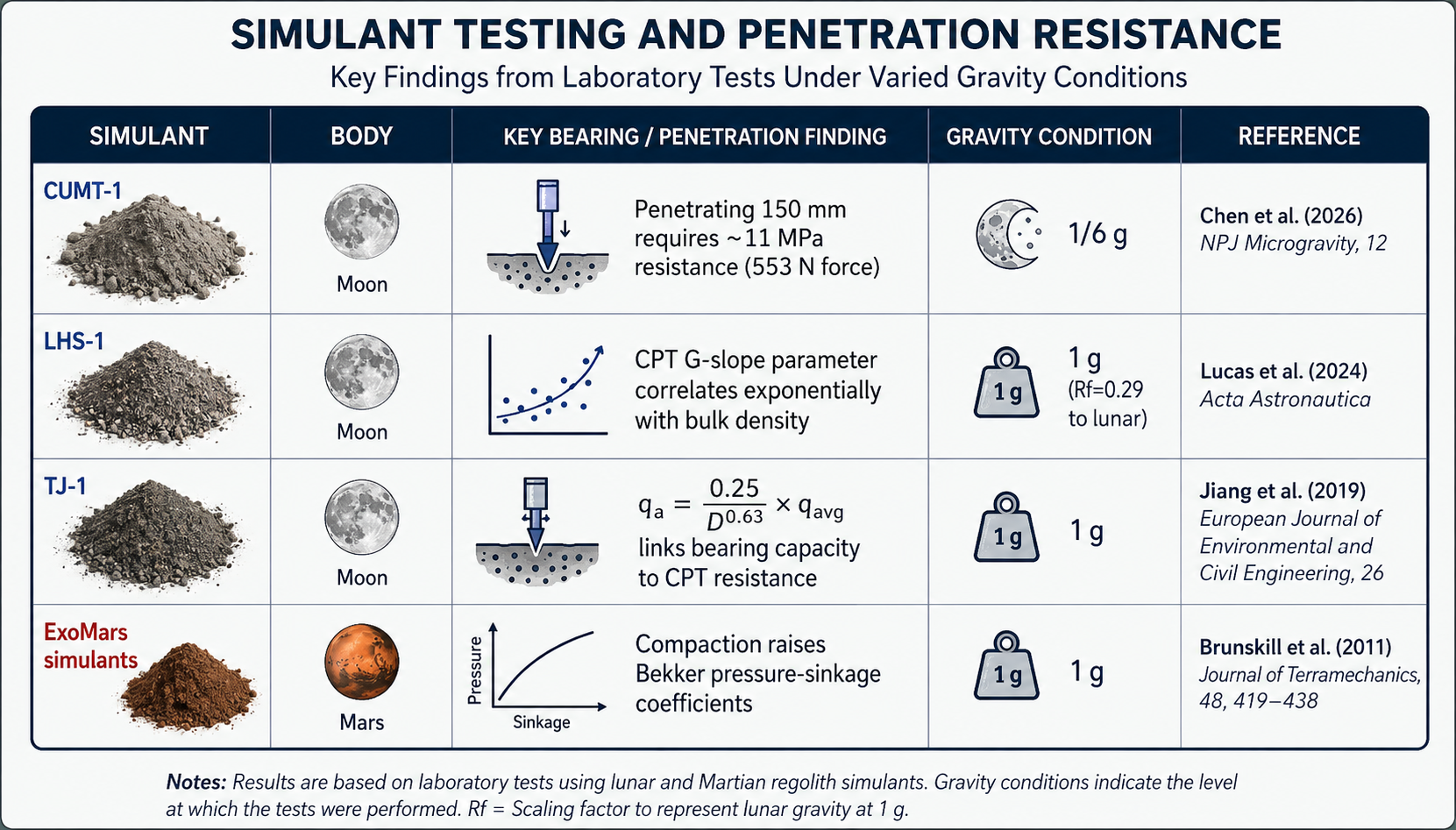
Since direct field testing on the Moon and Mars remains extremely limited, researchers rely on cone penetration tests (CPT) and high-fidelity lunar and Martian regolith simulants to estimate engineering parameters.
Laboratory experiments demonstrate that penetration resistance depends not only on reduced gravity but also on particle morphology, density, and compaction. Under lunar gravity (1/6 g), penetration resistance decreases only slightly, while the reduced self-weight of exploration equipment becomes the dominant limitation during drilling and penetration.
Density and Soil Mechanics
The engineering behavior of regolith is strongly controlled by its density and particle arrangement. Increased compaction leads to higher cohesion and shear strength, resulting in greater bearing capacity. Open databases of lunar regolith properties indicate bulk densities ranging from approximately 0.7 to 2.3 g/cm³, internal friction angles between 20° and 55°, and cohesion values reaching approximately 5 kPa depending on location and depth.
Because large-scale plate loading tests are impractical on planetary surfaces, cone penetration testing remains one of the most effective methods for estimating bearing capacity and deformation characteristics.
Lunar vs Martian Bearing Capacity
Lunar Regolith generally exhibits higher particle angularity, stronger interparticle friction, and greater sensitivity to particle crushing under repeated loading.
Martian Regolith is influenced by volcanic materials, weathering processes, subsurface ice, and local geological variability, producing more complex bearing behavior across different regions.
Engineering Applications
Bearing capacity directly influences the design of future extraterrestrial infrastructure.
- Lunar and Martian habitat foundations
- Landing pads
- Surface roads
- Autonomous construction robots
- Rover mobility analysis
- Excavation equipment
- ISRU facilities
Related Topics
- Geotechnical Site Investigation on the Moon and Mars
- Foundation Engineering for Lunar and Martian Structures
- lunar geotechnics
- martian geotechnics
- Planetary Soil Mechanics